
Cumberland County Criminal Court Records
A criminal court record is the court case file, not just the booking or arrest event. It begins once a criminal charge is filed and then grows as the case moves through hearings, bond orders, pleas, motions, trial settings, judgments, sentence entries, probation conditions, costs, restitution, and appeals. The Clerk of Superior Court is the practical custodian for Cumberland County Superior Court and District Court criminal case files.
Cumberland County is in Prosecutorial District 14, Superior Court District 14, and District Court District 14. Superior Court hears felony criminal cases and appeals from District Court. District Court handles misdemeanors, infractions, initial stages for many criminal matters, and related lower-court proceedings. Magistrates handle initial criminal processes, warrant matters, first appearances, and limited criminal functions.
The District Attorney for Prosecutorial District 14 prosecutes state criminal cases for Cumberland County. That office prepares criminal trial dockets, represents the State in criminal and some juvenile matters, and advises law enforcement. The DA role matters because the court record reflects charges as prosecuted, not merely the fact that someone was arrested.
Search Cumberland County Criminal Cases
The NC eCourts Portal is the first online search point for public criminal case information when the case is available online. Public self-service terminals in clerk offices are also available for criminal case information, with searches by defendant name, case number, or victim or witness name. The Judicial Branch specifically says background-check users should use the county clerk's office, not Portal alone.
- Use NC eCourts Portal case search when the defendant name, case number, citation, or other case identifier is known.
- Limit results by Cumberland County, criminal case type, case status, or filing-date range when those filters are available.
- Open the case to review charges, docket events, hearings, plea, disposition, sentence, and financial balances if public.
- Use a public clerk terminal for criminal case information that needs a courthouse search path.
- Request paper-file inspection or certified copies from the Clerk of Superior Court when the document itself is needed.
The charge-level path is related but narrower. A closer look at charges filed after arrest belongs on the Cumberland County arrest records and charges page, while this page keeps the focus on the full court case file and outcome.
Cumberland Criminal Case Flow
A Cumberland County criminal case can begin with an arrest, warrant, citation, indictment, or other criminal process. Once the court case opens, each step can produce a docket entry or document. Felony cases can move through District Court stages and then Superior Court. Misdemeanors and infractions generally remain in District Court unless an appeal or other procedure moves the matter.
Case flow: Charges Filed › Arraignment › Pretrial and Motions › Plea or Trial › Disposition › Sentencing
| Stage | What the Criminal Record May Show |
|---|---|
| Charges filed | Charge, statute, offense date, arrest date, bond, warrant or order information, and case number. |
| Arraignment | Appearance where charges and plea matters are addressed. |
| Pretrial and motions | Motions, orders, continuances, hearing settings, and bond or release conditions. |
| Plea or trial | Guilty plea, not guilty verdict, trial setting, dismissal, or other disposition event. |
| Sentencing | Sentence, probation, costs, restitution, conditions, and appeal entries if filed. |
Cumberland Criminal Record Fields
The visible detail depends on case type and public access level. Online records may show a summary, while the clerk file may include more documents. The research identifies criminal fields that can appear in court records, including charge, statute, offense date, arrest date, bond, plea, disposition, sentence, probation, costs, restitution, and warrant or order information.
| Field | What It Shows |
|---|---|
| Case number | The court identifier for the criminal file. |
| Defendant | The person charged in the criminal case. |
| Charge and statute | The offense filed and its legal reference when listed. |
| Offense and arrest dates | When the alleged offense and arrest occurred, if part of the public record. |
| Bond or release order | Conditions tied to release and future appearance. |
| Plea | The defendant's formal response to the charge. |
| Disposition | The outcome, such as guilty, dismissed, not guilty, or another result. |
| Sentence | Punishment or conditions after conviction, including probation, costs, and restitution where listed. |
Charges vs Convictions
A charge is an accusation filed into the court process. A conviction is a final outcome based on a guilty plea, verdict, or other conviction event. Cumberland County criminal court records can show charges that were dismissed, reduced, amended, or ended without a conviction. Read the disposition before treating a charge as an outcome.
| Point | Charge | Conviction |
|---|---|---|
| Stage | Accusation after criminal process or filing. | Outcome after plea, verdict, or court finding. |
| Record meaning | Shows what was alleged or filed. | Shows legal guilt or responsibility where entered. |
| Can change | May be amended, reduced, added, dismissed, or dropped. | May lead to sentence, probation, costs, restitution, or appeal. |
| How to verify | Review charge status and docket entries. | Review disposition, judgment, and sentence fields. |
Federal Criminal Records Separate
Cumberland County state criminal court records are separate from federal criminal records. Federal cases route to the U.S. District Court for the Eastern District of North Carolina. The Fayetteville federal courthouse is at 301 Green Street, but the EDNC Fayetteville location is listed as an unstaffed clerk's office, staffed only when court is in session. Pleadings may be filed in Raleigh, Greenville, New Bern, or Wilmington regardless of division or judge assignment.
The assigned image from the U.S. Attorney for the Eastern District of North Carolina shows the federal district source that includes Cumberland County.
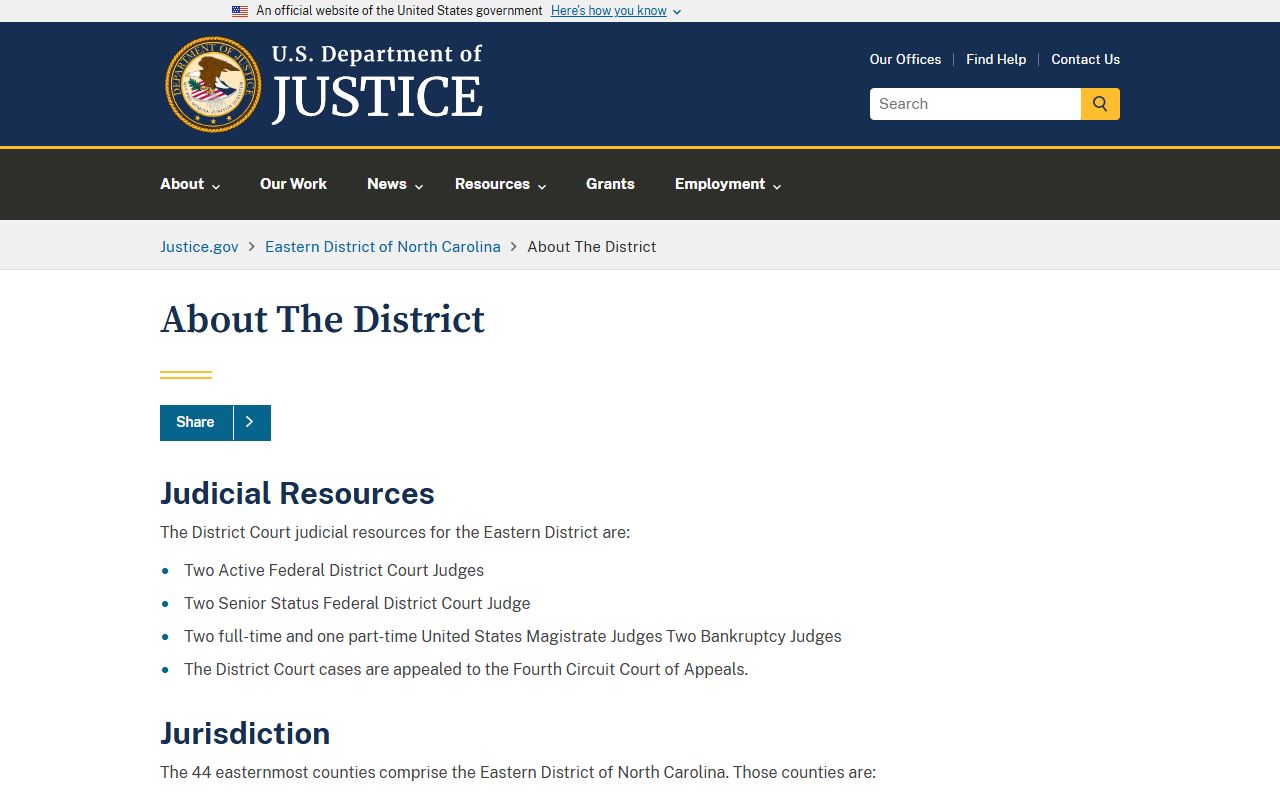
Use federal sources for federal prosecutions. Use the Cumberland County Clerk of Superior Court and NC eCourts for state criminal cases.
Federal dockets and documents may be accessed through PACER.
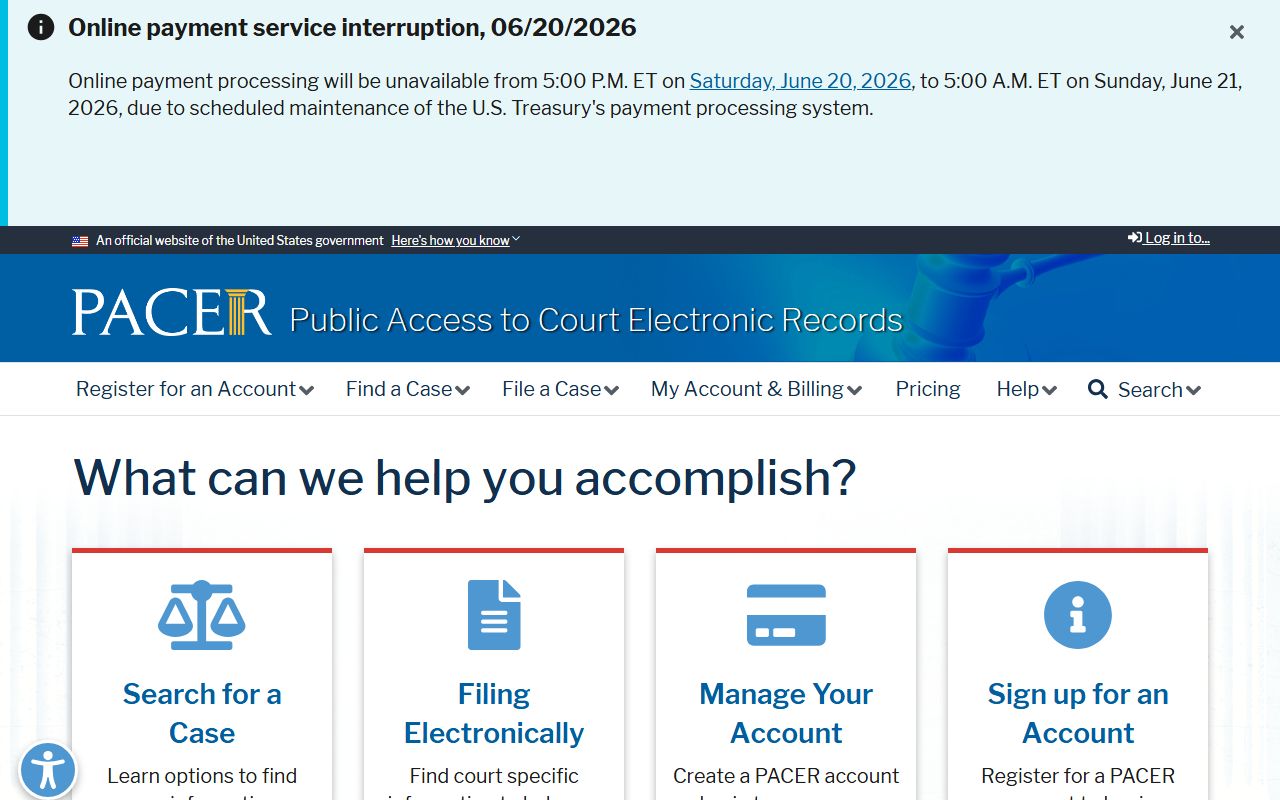
PACER does not replace the local state-court clerk file. It is for federal court records.
Official federal docket records should be checked through the federal court system when a certified or complete federal record is needed.
Sealed vs Expunged Records
Sealed and expunged criminal records are different. A sealed record is hidden from ordinary public view by law or court order. An expunged record is removed from ordinary public access under an expunction order, with paper and electronic records sealed, removed, or destroyed as directed by statute and order.
| Point | Sealed Record | Expunged Record |
|---|---|---|
| Public visibility | Not open to ordinary public inspection. | Removed from ordinary public-facing court and agency records. |
| Legal source | Law or court order. | Chapter 15A expunction provisions and court order. |
| Effect | Record may still exist but be hidden. | Person may generally deny the expunged arrest, charge, or conviction, subject to statutory exceptions. |
| Verification | Ask the clerk about authorized access or court-order requirements. | Use the expunction order and clerk process, not a public docket search. |
The assigned capture for N.C.G.S. 15A-151 documents the confidentiality rule for expunged court files.
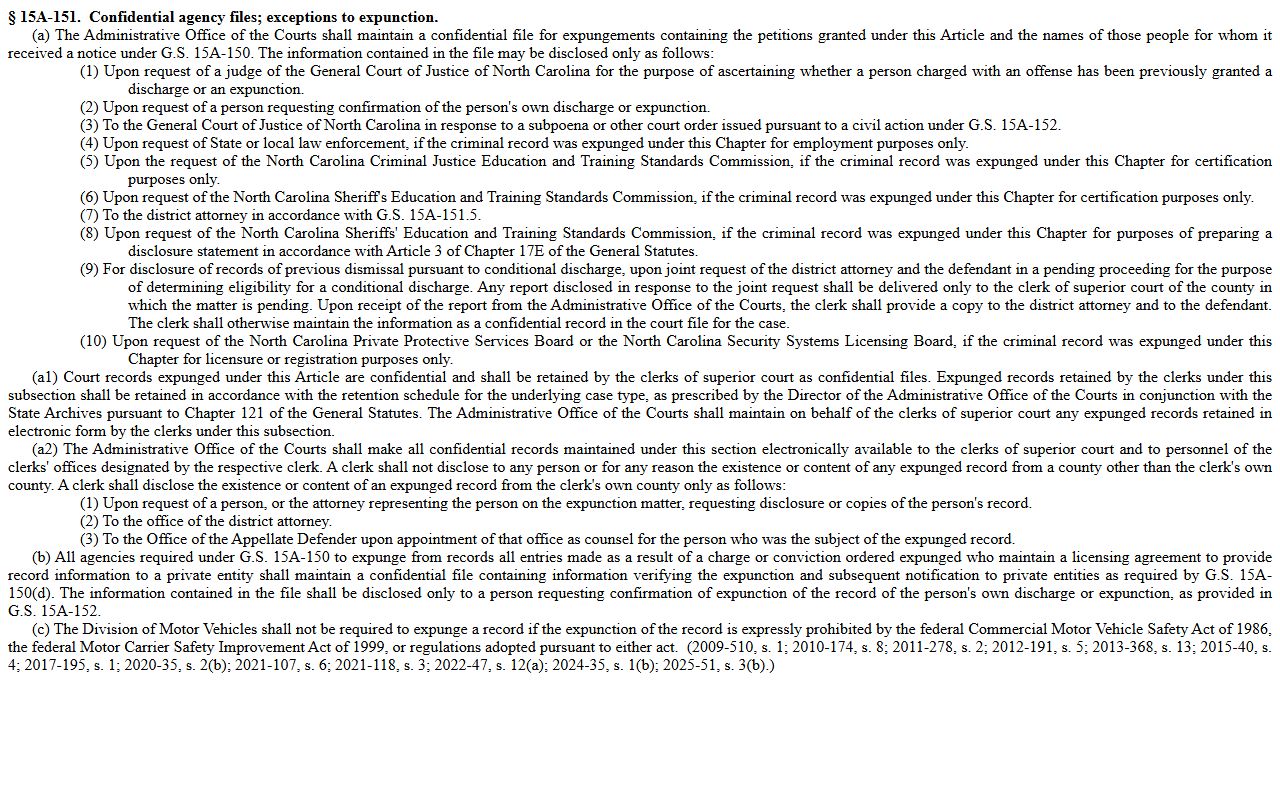
That statute explains why a public search may not show a criminal case after an expunction order is carried out.
The related effect statute, N.C.G.S. 15A-153, is also assigned to this topic.
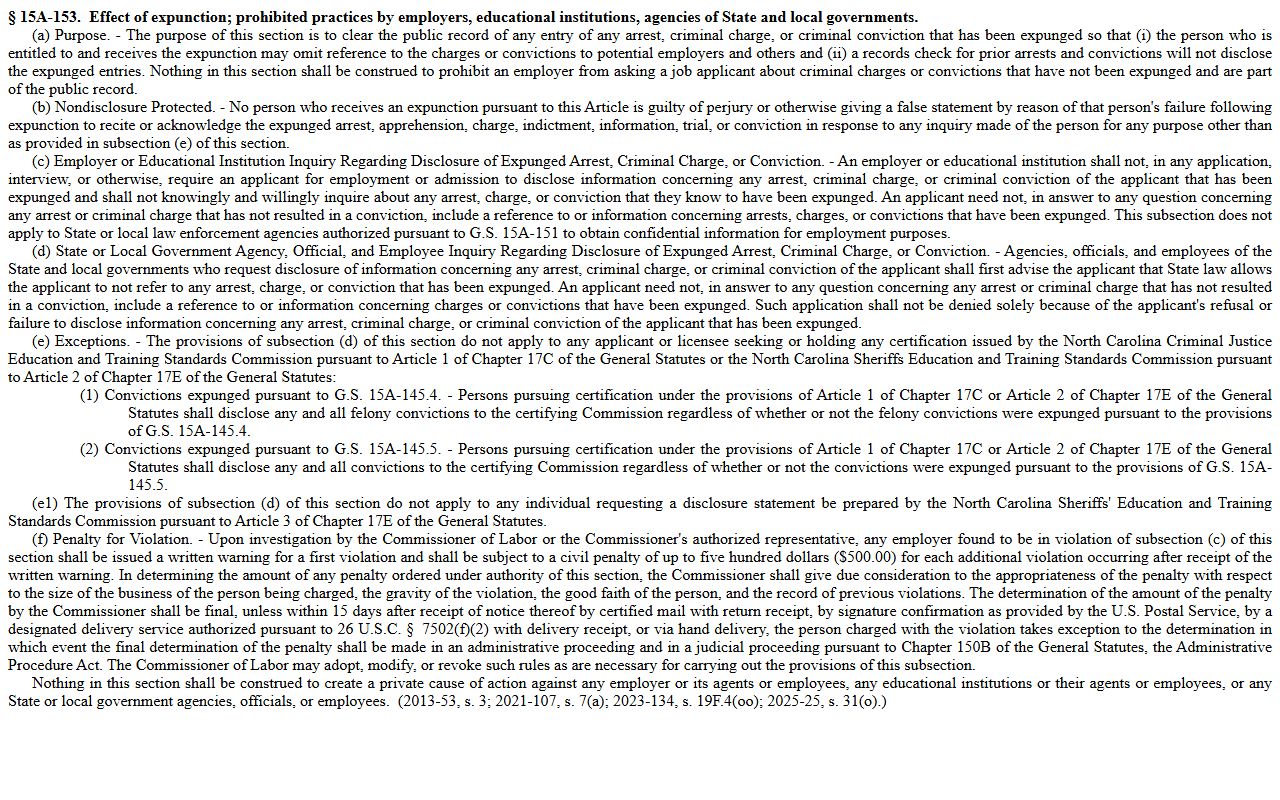
The effect statute should be read with the specific expunction category and order because exceptions can apply.
Cumberland Criminal Access Limits
North Carolina public-records law begins with broad access in N.C.G.S. 132-1 and inspection rights in N.C.G.S. 132-6. Criminal investigation and intelligence records are limited under Chapter 132, including N.C.G.S. 132-1.4, while court case files follow clerk and court access rules.
Juvenile delinquency records are confidential under N.C.G.S. 7B-3000. Abuse, neglect, and dependency records are restricted under N.C.G.S. 7B-2901. Sealed indictments, sealed warrants, protected minor information, mental-health matters, and redacted personal data may not appear in ordinary public views.
Note: A missing public result can mean no case, wrong search data, older paper access, sealing, expunction, or another confidentiality rule.
Cumberland Criminal Court Contacts
The Clerk of Superior Court is the contact for criminal case records, public terminals, paper files, and certified copies. The District Attorney is the prosecution office. The official District Attorney source lists District Attorney Billy West for Prosecutorial District 14, with the office at the Cumberland County Courthouse, Suite 427, and phone 910-475-3010.
Public Defender information has a research-source conflict. The NCIDS county page listed Cynthia Page Black, but a dated January 8, 2026 NCIDS announcement states Adam Phillips was sworn in on January 1, 2026 as the new Chief Public Defender for District 14. Use the dated 2026 announcement when current defender leadership matters, and use the Public Defender office phone 910-475-3023 for office contact.
Clerk of Superior Court
117 Dick St.
Fayetteville, NC 28301
910-475-3000
Monday-Friday, 8:00 AM-5:00 PM
District Attorney
117 Dick St., Suite 427
Fayetteville, NC 28301
910-475-3010
Prosecutorial District 14